

SHEZ Construction Chemicals: Choosing the Right Solution for the Job
Construction chemicals solve specific technical problems: bonding tiles, sealing water paths, repairing concrete, protecting façades, grouting voids and creating durable industrial floors.
Because many products look similar in a bag or bucket, selection should begin with the application and performance requirement — not the product name.
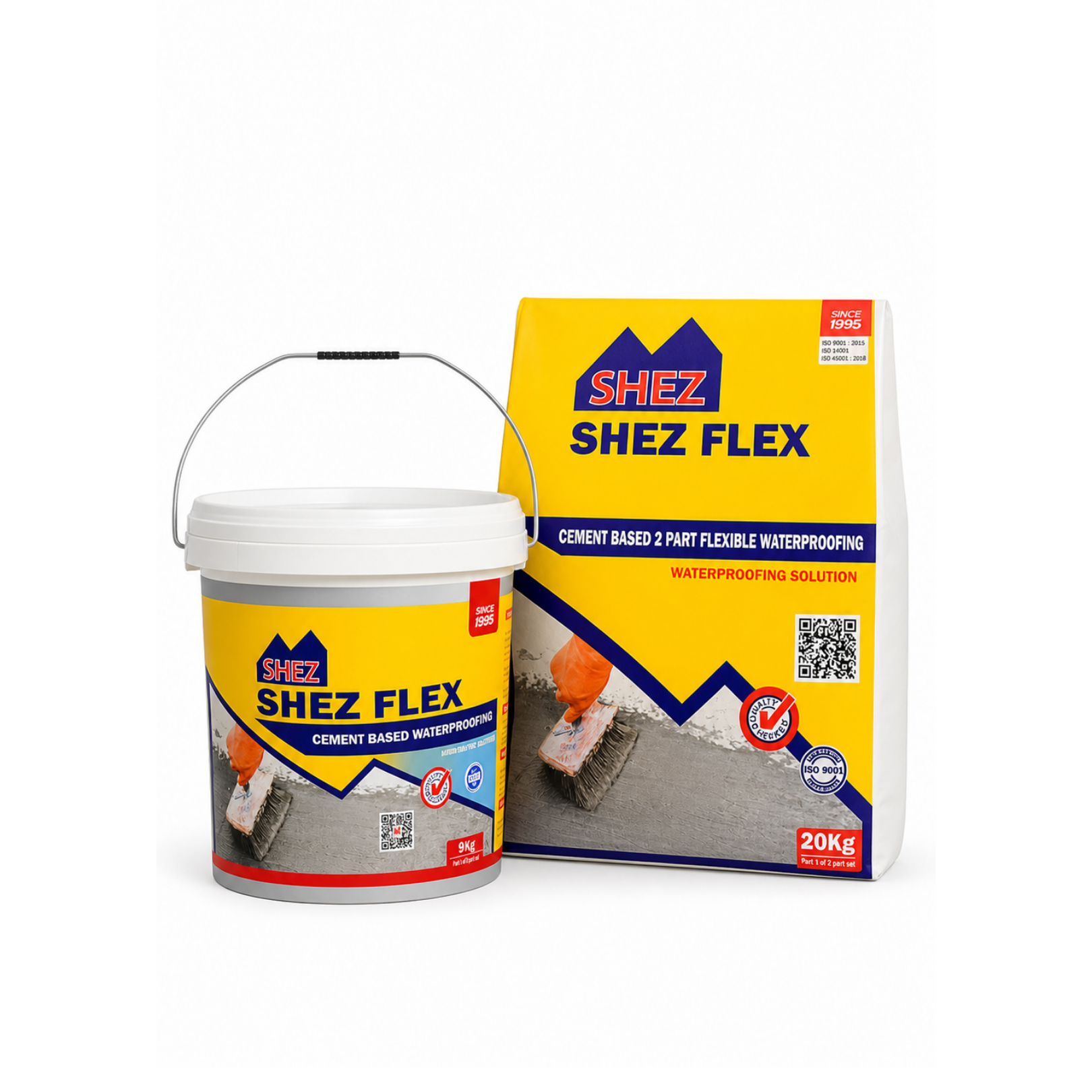
SHEZ is H.E. Engineering's in-house range of construction chemicals manufactured in Sri Lanka under controlled production. This guide explains how to think about choosing construction chemical solutions across a project.
Start with the problem you are solving
Before selecting a product, define:
- the substrate
- whether the area is wet or dry
- internal or external exposure
- expected movement
- traffic or loading
- chemical exposure
- temperature and UV exposure
- whether the material will be permanently immersed
- required finish; and
- what other materials must bond to it.
This immediately narrows the suitable product category.
Waterproofing
Waterproofing is not one application. A roof, bathroom, basement and water tank require different performance.
H.E. Engineering's waterproofing services include systems for:
- basements
- rooftops and terraces
- toilets
- balconies
- swimming pools
- planters
- roof gardens
- external walls
- water-retaining structures
- bridge decks; and
- lift wells.
Depending on the location, technologies can include flexible cementitious coatings, polyurethane and hybrid liquid membranes, sheet membranes, crystallisation systems, concrete admixtures and root-resistant systems.
Selection principle
Choose according to exposure and substrate. A material designed beneath tiles may not be the correct exposed roof coating, and an external roof system may not be appropriate for permanent water immersion.
Concrete repair
Damaged concrete may require cementitious or resin-based repair materials depending on depth, geometry, structural requirement and exposure.
H.E. Engineering lists concrete repair products including fibre-reinforced cement mortar, non-fibrated repair mortar, epoxy repair mortar, micro-concrete and epoxy repair putty.
Selection principle
Do not select repair mortar before identifying why the concrete failed. Corrosion, impact, cracking, poor compaction and chemical attack may require different preparation and protection strategies.
Grouting and injection
Grouts are used for a broad range of applications, from filling voids to sealing cracks and transferring loads.
H.E. Engineering provides cementitious, epoxy and polyurethane injection grouting within its specialist services.
Selection principle
Determine whether the objective is structural bonding, void filling, water stopping or another function. Also consider whether the defect is wet, dry, moving or dormant.
Tile adhesive and grout
Tile installations depend on the relationship between substrate, waterproofing, adhesive, tile and joints.
Selection principle
Consider tile porosity, size, weight, location, moisture exposure and substrate. Dense porcelain and large-format tiles can place different demands on adhesive than small porous ceramic tiles.
Tile grout is also not a replacement for waterproofing beneath a wet-area finish.
Industrial flooring
Factories and warehouses may require resin flooring for cleanability, chemical resistance, abrasion resistance or dust control.
H.E. Engineering provides heavy-duty epoxy and polyurethane flooring systems.
Selection principle
Define traffic, chemical exposure, cleaning methods, slip requirements, UV exposure, downtime and slab moisture before choosing a resin system.
Protective coatings
Concrete and masonry façades can be exposed to rain, UV, carbonation and coastal conditions.
H.E. Engineering provides specialised external coatings including UV-resistant and anti-carbonation solutions.
Selection principle
Decide whether the coating's primary role is waterproofing, decorative protection, anti-carbonation performance, heat reflection or a combination. Breathability can also be important on moisture-sensitive substrates.
Thermal insulation and heat protection
Sri Lankan roofs receive intense solar radiation. Thermal insulation and heat-reflective systems can help reduce heat transfer and roof surface temperature when correctly designed.
Selection principle
Treat thermal performance as part of the complete roof assembly. Waterproofing, insulation, drainage and exposed finishes should be compatible.
Sealants and waterstops
Joints are deliberate points of movement or construction discontinuity. They require materials designed to accommodate that function.
Selection principle
Consider joint width, expected movement, exposure, substrate adhesion and whether the joint is subjected to water pressure.
Rigidly filling a movement joint can simply transfer cracking elsewhere.
Why system compatibility matters
A construction chemical rarely operates alone.
A bathroom may include:
- concrete or screed
- repair and levelling materials
- waterproofing
- tile adhesive
- tile; and
- grout and sealant.
If these layers are incompatible, the failure may occur between them even though each product is individually good.
The same applies to a repaired façade where repair mortar, primer and protective coating must work as one system.
Why application quality matters as much as product quality
Construction chemicals are manufactured under controlled conditions, but they are applied on construction sites where temperature, moisture, mixing, preparation and workmanship vary.
Follow the technical data sheet for:
- mixing ratio
- pot life
- coverage
- substrate condition
- application thickness
- number of coats
- waiting times
- curing; and
- limitations.
Do not dilute or modify a product simply to make application easier unless the manufacturer specifically permits it.
Local manufacturing and technical support
H.E. Engineering describes SHEZ as its locally manufactured range of high-performance construction chemicals, produced under strict quality control.
The advantage of selecting through a specialist engineering supplier is not only access to a product. Technical support can help determine whether that product actually belongs in the proposed system.
H.E. Engineering has operated since 1995 as a specialist contractor and material supplier and is part of the H.E. Group established in 1907. The company states that it has more than 4,500 project references across Sri Lanka and the Maldives and holds ISO 9001:2015 certification.
A simple product-selection checklist
Before purchasing a construction chemical, ask:
- What exact problem am I solving?
- What is the substrate?
- Is the area internal, external or immersed?
- Will the substrate move?
- Is there water pressure?
- Is the area exposed to UV?
- What loads or traffic will it receive?
- What material comes before and after this layer?
- What preparation is required? 10. Can the applicator meet the specified mixing, thickness and curing requirements?
If several answers are unknown, obtain technical advice before selecting the material.
Frequently asked questions
Is one waterproofing product suitable for an entire building?
Usually not. Roofs, basements, wet areas, pools and façades have different exposure conditions.
Are locally manufactured construction chemicals suitable for major projects?
Suitability depends on the specific product's tested properties, quality control and project specification — not simply the country of manufacture. SHEZ is H.E. Engineering's locally manufactured range.
Can I choose a product based only on price per kilogram?
That can be misleading. Coverage, required thickness, preparation, labour, durability and compatibility all affect installed cost.
Why should I follow the technical data sheet?
Because construction chemicals are engineered to perform within defined mixing, application and curing conditions.
Final thought
The most important step in choosing a construction chemical is matching the material to the actual engineering requirement.
Whether the project involves waterproofing, concrete repair, injection grouting, industrial flooring, coatings or tile installation, H.E. Engineering can provide technical guidance and suitable SHEZ or specialist construction solutions for projects in Sri Lanka and the Maldives.