

Industrial Epoxy Flooring: A Practical Guide for Factories and Warehouses
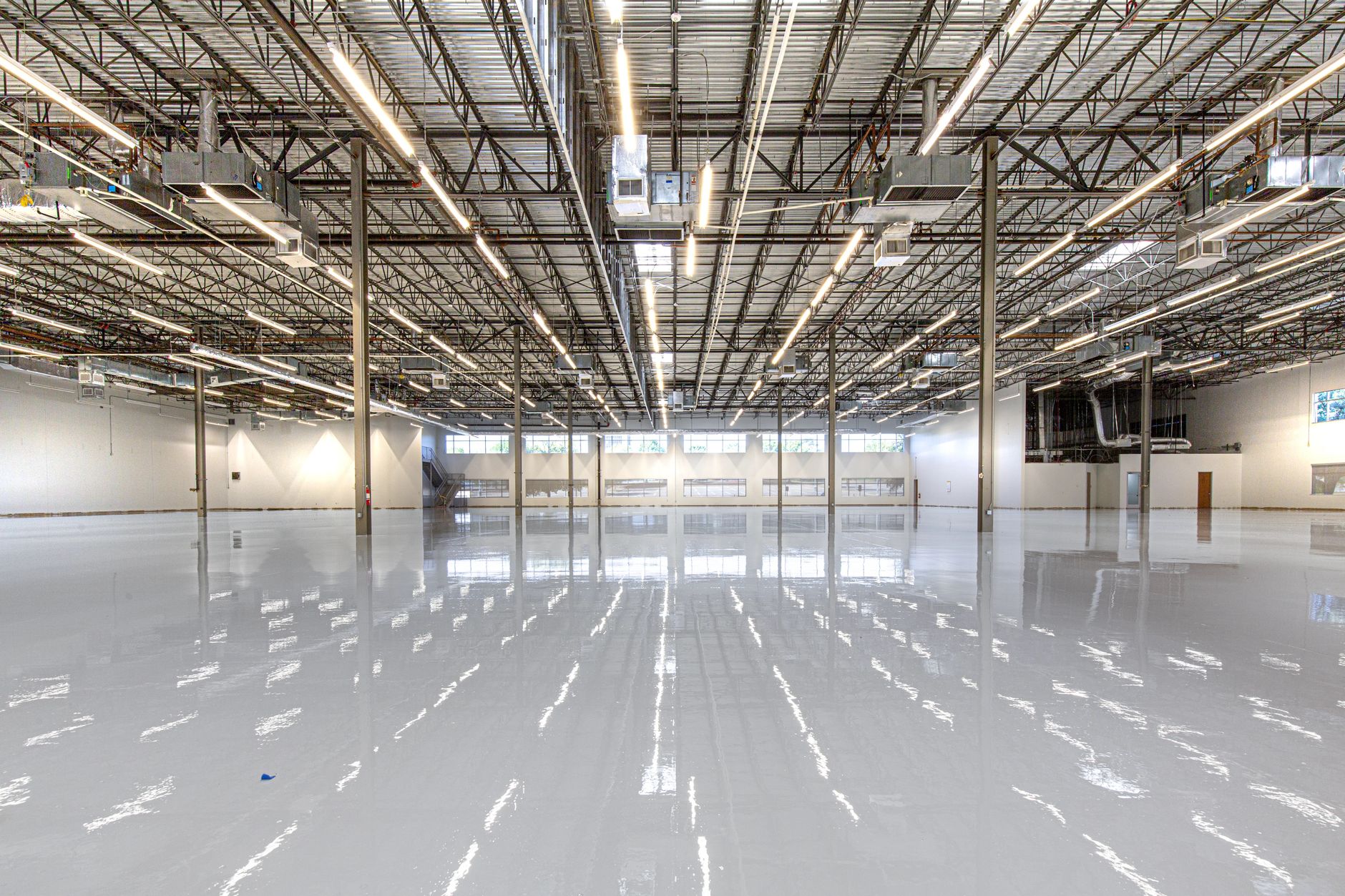
Factory and warehouse floors are working surfaces. They carry forklifts, pallets, production equipment, foot traffic, cleaning operations and, depending on the industry, oils, chemicals and repeated impacts.
Bare concrete can be perfectly suitable in some environments. In others, an industrial resin flooring system can improve cleanability, chemical resistance, appearance and protection of the underlying concrete.
Epoxy flooring is one of the most established options, but it should be specified according to service conditions rather than selected because a glossy floor looks attractive.
What is an epoxy floor?
An epoxy flooring system uses resin and hardener components that chemically react to form a hard, bonded surface.
Industrial systems can range from relatively thin coatings to thicker self-smoothing or mortar systems. The correct build-up depends on the substrate, traffic, chemical exposure, required finish and expected service life.
H.E. Engineering provides heavy-duty epoxy and polyurethane flooring systems for factories, warehouses and other industrial environments.
Where epoxy flooring performs well
Epoxy systems are commonly considered for:
- warehouses
- production areas
- workshops
- pharmaceutical and healthcare environments
- commercial back-of-house areas
- parking and service areas where the system is suitably specified
- laboratories; and
- facilities where cleanability and dust control are priorities.
The exact suitability depends on the system rather than the word "epoxy" alone.
Key benefits
Seamless finish
A resin floor can create a continuous surface with fewer joints than many conventional finishes. This can make cleaning easier and reduce places where dirt accumulates.
Protection of concrete
A correctly bonded coating reduces direct exposure of the concrete to abrasion, liquids and contaminants within the limits of the specified system.
Chemical resistance
Epoxy formulations can resist many chemicals, but resistance varies by formulation, concentration, temperature and duration of exposure.
Always review a chemical-resistance schedule for the actual substances used in the facility.
Improved housekeeping
Sealed resin floors reduce concrete dusting and can provide a surface that is easier to clean.
Visual zoning
Industrial floors can incorporate different areas for walkways, work zones or safety markings, subject to the facility's requirements.
Epoxy is not ideal for every condition
A common mistake is treating "epoxy flooring" as a universal solution.
UV exposure
Some epoxies can yellow or chalk under sunlight. Exposed external areas may require UV-stable alternatives or protective topcoats.
Thermal shock
Areas exposed to hot washdown, steam or rapid temperature changes can require specialised systems.
Substrate moisture
Moisture vapour or water beneath the coating can cause blistering and loss of adhesion. The slab condition should be assessed before application.
Movement
Cracks and joints in concrete need appropriate treatment. A rigid coating cannot prevent structural movement beneath it.
Slip
A very smooth floor may be unsuitable in wet or oily areas. Aggregate and texture can be incorporated to achieve the required slip resistance, but increased texture may also affect cleanability.
Epoxy versus polyurethane flooring
Both are broad material families with many formulations.
Epoxy systems are known for adhesion, hardness and chemical resistance. Polyurethane systems can offer greater flexibility and, depending on formulation, improved resistance to UV or certain thermal conditions.
The choice should be based on the facility's exposure, not a generic "epoxy vs PU" rule.
Surface preparation: the foundation of performance
Industrial flooring failures frequently begin at the interface between coating and concrete.
The substrate should be:
- structurally sound
- sufficiently cured
- free from oil and contamination
- mechanically prepared to the required profile
- repaired where defective; and
- assessed for moisture.
Mechanical preparation methods may be required to remove weak surface laitance and create a suitable profile for bonding.
Why moisture testing matters
Concrete can appear dry at the surface while still transmitting moisture from below. If a low-permeability coating is applied without understanding moisture conditions, pressure can develop at the interface.
The project specification should address slab moisture, ground conditions and any required moisture-control system.
Selecting a flooring system
Before specifying a floor, answer these questions:
- What vehicles and loads will use the floor?
- Will steel wheels or hard castors be present?
- What chemicals can spill?
- How is the floor cleaned?
- Is hot water or steam used?
- Is the area exposed to sunlight?
- What slip resistance is required?
- How important is appearance?
- How much downtime is available for installation? 10. What is the condition and moisture level of the existing slab?
These answers provide a far better basis for selection than choosing by thickness or colour alone.
Maintenance and repair
Industrial floors should be cleaned using methods compatible with the coating. Damaged areas should be repaired before impact or chemical exposure enlarges the defect.
Traffic patterns also matter. Turning zones, loading points and entrances often wear faster than open floor areas. A maintenance plan should recognise these high-stress zones.
H.E. Engineering industrial flooring
H.E. Engineering provides industrial flooring as one of its specialised engineering services, alongside concrete rehabilitation, waterproofing, coatings, thermal insulation and grouting.
This combination is useful in refurbishment projects because a floor coating should not be installed over deteriorated concrete without repairing the substrate first.
Frequently asked questions
How long does epoxy flooring last?
There is no universal lifespan. Thickness, formulation, traffic, substrate, installation quality, chemical exposure and maintenance all influence service life.
Is epoxy flooring slippery?
It can be if a smooth finish is used in a wet environment. Slip-resistant textures and aggregates can be specified.
Can epoxy be applied to old concrete?
Often yes, provided the concrete is sound and can be correctly prepared. Contamination, moisture and existing coatings must be assessed.
Can epoxy repair cracked concrete?
No. Cracks and structural defects should be assessed and repaired appropriately before the flooring system is installed.
Final thought
The best industrial floor is not necessarily the thickest or most expensive. It is the system whose properties match the actual operation of the facility.
H.E. Engineering can assess industrial flooring requirements and recommend epoxy, polyurethane and associated concrete repair solutions for factories, warehouses and commercial facilities.